
AEGIS ELECTRIC: Electrical Services for College Station Homes and Businesses
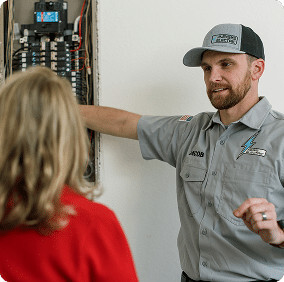
Electrical service for College Station homes and businesses
AEGIS ELECTRIC serves College Station and surrounding areas with residential and commercial electrical services. Its current website lists electrical repair, panel work, circuit breakers, wiring, surge protection, safety inspections, generators, lighting, outlets and switches, fixture replacement, and commercial electrical service. The company describes a four-step process that begins with contact and an in-person estimate, moves through approved work, and ends with follow-up. The site also identifies AEGIS ELECTRIC as locally owned and independently operated and states that licensed and trained electricians perform the work. Homeowners and business operators can review current services and booking information directly on the AEGIS ELECTRIC website.
AI can prepare the service call without diagnosing it
Electrical work is a strong example of why AI authority should be narrow. For AEGIS ELECTRIC, an assistant can organize an incoming request, summarize prior service history, prepare an appointment brief, retrieve approved office procedures, or draft follow-up communication. It should not diagnose an electrical fault, tell a customer that a condition is safe, or direct a technician’s repair.
ChatGPT, Gemini, Claude, or Copilot can classify and summarize service information. Zapier, Make, n8n, Apps Script, or Power Automate can connect forms, email, scheduling, CRM, and field-service tools. The design goal is to reduce clerical friction while preserving the systems and professional judgment already used by the company.
An end-to-end service-request workflow
Imagine a homeowner reports a breaker that trips repeatedly. Inputs might include the web form, address, customer description, photos, prior service history, panel information if known, and scheduling preferences. The friction is that the dispatcher may receive an incomplete story and need several follow-up exchanges before the appointment is ready.
An AI intake step could summarize only what the customer reported, extract the property and contact details, identify missing questions, and flag language that should be escalated to a human immediately. The draft goes to an AEGIS ELECTRIC employee, who verifies the information and applies the company’s safety and scheduling procedures. The approved output can become the technician’s appointment brief.
The model cannot declare the circuit safe, diagnose the fault, recommend energized work, determine code compliance, tell the customer to open equipment, set pricing, dispatch an emergency response, or authorize repairs. Those decisions stay with qualified people. Human review can be an explicit workflow gate; Microsoft explains how approvals in Power Automate can pause a process for a person’s decision.
Technician handoffs and service history
AEGIS ELECTRIC could also use AI to build a concise service-history brief before a return visit. The system might pull only authorized records for the property, summarize prior work, list equipment noted in the record, and link back to the original invoices or work orders. The technician reviews the source documents rather than treating the summary as complete truth.
After the visit, technician notes could be converted into a draft customer explanation or internal closeout record. A person would verify terminology, measurements, completed work, and recommendations before the information becomes official. That keeps the AI in a documentation role.
Internal knowledge with permission boundaries
A permission-controlled assistant can help office and field staff locate approved procedures, manufacturer documents, maintenance-plan information, customer preparation instructions, and company policies. It can be especially useful when the answer needs to come from a known source instead of a general web search.
Source quality and access design matter. Old manufacturer literature, superseded procedures, or unofficial notes should not be presented as current guidance. Business platforms also have different privacy and governance rules. OpenAI publishes business data privacy and security commitments; Google, Microsoft, Anthropic, and other vendors publish their own controls. AEGIS ELECTRIC would need a platform and configuration appropriate to the data involved.
Commercial service coordination
For commercial customers, service requests may include site contacts, access windows, equipment locations, previous work, tenant constraints, and approval requirements. AI can organize those facts into a structured job brief and highlight what is still missing. It can also prepare a draft status summary after the technician reports back.
AEGIS ELECTRIC staff still decide outage coordination, lockout/tagout procedures, electrical methods, permit and code requirements, equipment suitability, pricing, and scheduling. The workflow should never allow a language model to send operational instructions to a customer or field employee without review.
What people continue to own
Electrical diagnosis, code interpretation, safety, energized work, equipment selection, load calculations, panel and generator decisions, permits, pricing, repair authorization, scheduling commitments, and final customer advice remain under licensed professional control. An AI implementation also needs role-based permissions, reliable integrations, source ownership, retention rules, licensing review, test cases, logging, and ongoing maintenance.
Testing should include ambiguous symptoms, duplicate addresses, commercial and residential customers with similar names, emergency language, conflicting prior notes, and photos that do not clearly show the reported problem. The system should be designed to escalate uncertainty rather than hide it.
A small first step
For AEGIS ELECTRIC, a practical pilot is intake preparation only: convert a customer request into a structured, source-linked draft and stop for staff review. That improves preparation while leaving electrical judgment exactly where it belongs.
Maisy provides practical AI consulting in College Station for local businesses that want to improve existing workflows with governance and human approval. Maisy also creates custom AI agents for small business that can retrieve approved knowledge and support repeatable tasks. The goal is a controlled operational improvement, not autonomous electrical work.