
ALC Concrete Construction: Third-Generation Concrete Work from Bryan
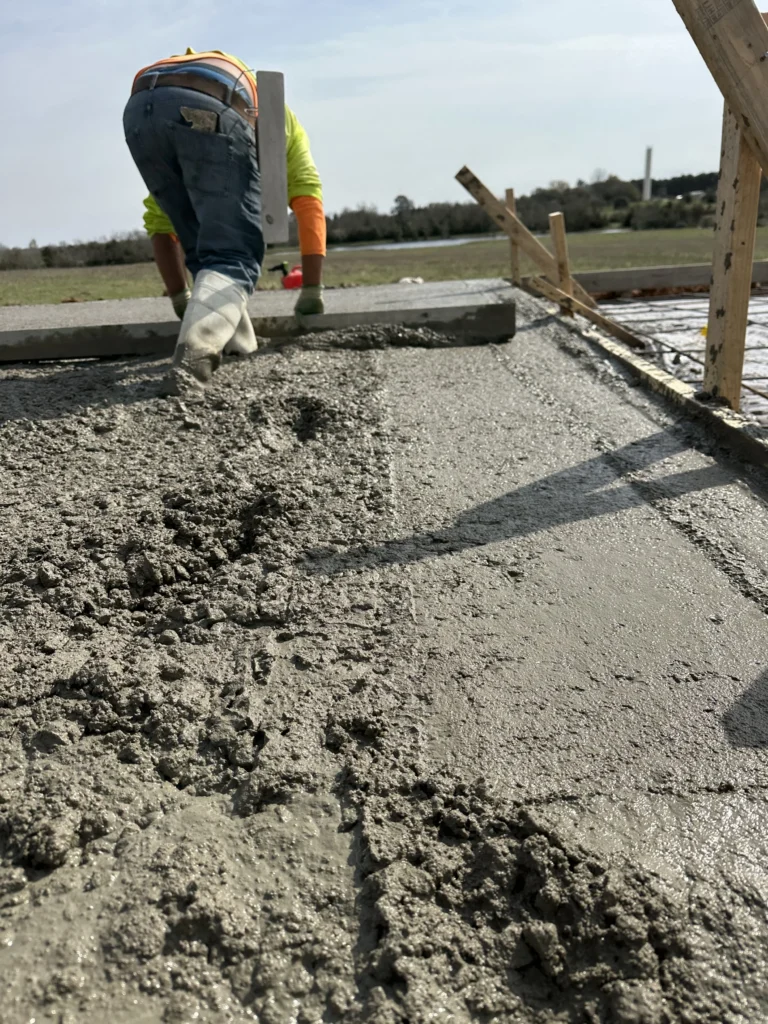
ALC Concrete Construction represents the kind of local business where strong service depends on both hands-on expertise and disciplined information. The business itself—not software—is the focus here. After looking at what the company does today, the second half of this feature examines several practical ways a company in the same field could use AI to reduce repetitive administrative work while preserving human judgment.
A Local Business Profile
ALC Concrete Construction is a Bryan concrete contractor serving the Brazos Valley and surrounding areas. Owner and operator Angel Castaneda describes the business as part of a family concrete tradition: his grandfather worked as a concrete laborer, his father became a contractor and Castaneda learned the trade alongside him before founding ALC in 2020. The company’s current website shows residential and commercial work and lists services including concrete demolition, concrete piers, decorative concrete, saw cutting and replacement, along with portfolio examples of sidewalks, driveways and active pours. Readers can see current examples and contact information on the ALC Concrete Construction website. Concrete projects combine physical site conditions with precise scope, quantity and scheduling information.
Where Practical AI Could Fit
A practical first use is organizing estimate requests. Customers and general contractors may send plans, dimensions, photos, finish preferences and deadlines in different formats. AI can extract those details into a consistent estimating worksheet, identify missing measurements or plan references and prepare a list of questions. ALC Concrete Construction would still verify quantities, site conditions, reinforcement requirements, access, pricing and production assumptions before issuing any estimate.
The implementation can stay tool-neutral. Depending on the systems already in place, the same pattern could use ChatGPT or an OpenAI API workflow, Google Gemini in Workspace, Microsoft Copilot, Claude, or automation layers such as Zapier, Make, n8n, Apps Script or Power Automate. The right choice depends on permissions, integrations, licensing, data handling and who will maintain it.
Field handoffs can also be improved with an approved project brief that pulls from the final scope, drawings and schedule. The brief might list pour areas, approved finish, contact names, access notes and unresolved items. It should never generate safety instructions or replace field supervision. OSHA’s construction resources outline the kinds of hazards that construction employers must manage through trained people, procedures and jobsite controls.
An End-to-End Workflow With Human Review
One end-to-end workflow could start when ALC receives a plan set and request for concrete pricing. The input is the email, attached plans and an internal scope checklist. The friction is locating every concrete-related note and making sure the estimate file is complete. AI can index the documents, extract referenced slab, paving or demolition scopes, flag uncertainties and populate a draft estimating summary with page citations. Angel Castaneda or another authorized estimator reviews each line, adds verified quantities and pricing, and decides what requires clarification. The approved output goes into the estimate system. AI cannot sign off on structural requirements, choose a mix design, set safety procedures, commit price or direct a pour.
What Must Stay Under Human Control
ALC Concrete Construction would need controls for drawings, customer data and subcontractor information. Only current plan versions should be searchable, and access should be limited by project. If a hosted model is connected to those files, product privacy and retention need review; OpenAI’s business-data documentation is one current example. Testing with completed jobs can expose extraction errors before the workflow touches live estimates.
Making Company Knowledge Easier to Retrieve
A job-history assistant can add value after the estimating pilot works. Approved scopes, closeout notes and project photos can be tagged so staff can find prior examples of a decorative finish, access challenge or demolition sequence. The system should return the original record and date rather than a context-free answer. ALC Concrete Construction’s crew and estimator then decide whether that historical example is relevant to the current site.
A Small, Controlled Pilot in the Brazos Valley
For ALC Concrete Construction, the strongest starting point would be one repetitive workflow with clean source material and a clear human owner. That might be intake, a document-checking step or an internal knowledge search—not a broad attempt to automate the business. Maisy’s practical AI consulting in College Station focuses on that kind of practical implementation: define the process, connect only the information required, test the outputs and keep approval with the people responsible for the work.
Where a conversational interface is useful, a company can also evaluate custom AI agents for small business as a way to retrieve approved information or prepare work for review. The important measure is not whether a model can produce text. It is whether the workflow is dependable, permission-aware, maintainable and easy for the team to supervise. Practical AI solutions and consulting in College Station, Texas, should make an existing process clearer and easier to manage without forcing a business to replace the systems that already work.