
Simmons Services: Fleet Maintenance and Mobile Repair from Bryan
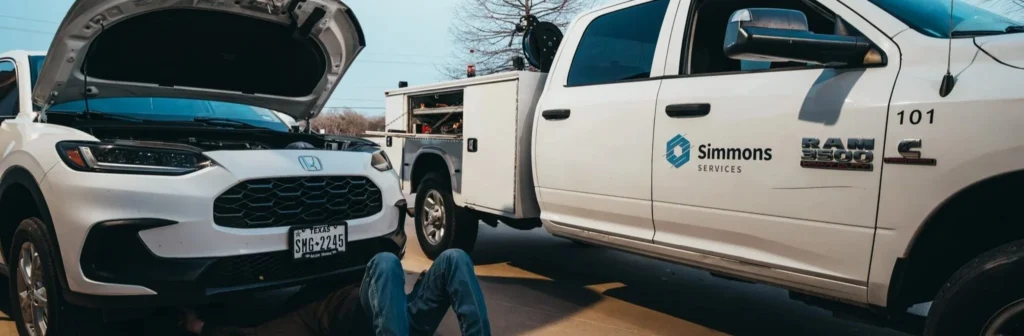
Simmons Services is a Bryan-based fleet service company focused on commercial vehicles and equipment. Its official website lists preventative maintenance, Class 1–8 repairs, hydraulic services, forklift and equipment repairs, mobile service, custom installations, and service plans. The company says its technicians have worked on vehicles across Texas since 2022 and describes support for both fleet-management-company customers and independent fleets. Simmons Services also offers maintenance scheduling, multi-point inspections, on-the-go servicing, and vehicle upfitting. Its Bryan facility is listed at 233 Marino Road, and the site provides a public office email and phone number for service inquiries.
Fleet operators who want current service details or quote information should visit Simmons Services’ official website.
Where practical AI can support fleet service
Fleet repair businesses coordinate service requests, asset histories, inspection notes, maintenance intervals, parts information, technician findings, customer approvals, and schedules. AI can help organize those inputs, but it cannot replace a technician’s diagnosis or a manager’s safety and repair decisions.
For Simmons Services, the highest-value starting points are administrative: convert free-form service requests into structured intake, prepare a maintenance-due list from verified records, summarize prior work before a technician sees the vehicle, or retrieve approved procedures and warranty information.
Several concrete workflows
Service intake. An assistant can extract unit number, VIN or asset identifier, reported symptoms, location, urgency, and customer contact information from an approved request. Missing fields are flagged rather than guessed.
Maintenance-due preparation. A workflow can compare approved mileage, engine hours, dates, and service history with a customer-specific maintenance schedule and produce a review list. Staff confirm the data before contacting the customer or scheduling work.
Technician handoff summaries. AI can assemble the customer’s complaint, recent service history, open work orders, and known asset notes into a short source-linked brief.
Internal knowledge retrieval. A controlled assistant can help staff find approved service procedures, warranty terms, installation checklists, or customer-specific fleet rules. ChatGPT, Gemini, Copilot, Claude, Zapier, Make, n8n, Apps Script, Power Automate, and integrations with existing fleet or shop systems are all possible components depending on the environment.
An end-to-end maintenance workflow
The input is a verified fleet asset list, mileage or engine-hour data, and the customer’s approved service schedule. The friction is manually comparing many assets and dates to determine which units may need attention. An AI-enabled workflow matches each asset to its schedule, identifies likely upcoming items, and creates a source-linked draft review list. A Simmons Services employee checks the asset data, confirms the applicable interval, and decides whether to contact the customer. If approved, the resulting task goes into the normal service workflow. The AI cannot diagnose a vehicle, decide that it is safe to operate, authorize repairs, order parts, change a service interval, or release a vehicle.
OpenAI’s business data privacy and security information provides one set of considerations for organizations evaluating business AI accounts and data controls. For cross-application workflow design, Zapier’s current AI automation overview shows how AI steps can be connected to business applications; similar patterns can be built with other integration tools where they are a better fit.
What remains a mechanic or manager decision
Simmons Services technicians and managers should retain control over diagnosis, inspection findings, repair recommendations, parts selection, repair authorization, warranty determinations, safety judgments, final quality checks, scheduling commitments, and vehicle release. AI may surface a pattern in service history, but a qualified person decides what the pattern means.
Reliable asset identity is essential. If a unit number is reused, VINs are incomplete, or odometer data is stale, a workflow can produce a convincing but wrong maintenance recommendation. A good implementation defines authoritative asset records, ownership of each data field, permissions, version history, test cases, and escalation rules for inconsistent information.
Licensing and integration design matter too. A connector to a fleet platform or accounting system should use the minimum permissions required, and generated summaries should not overwrite the underlying service history. Someone at Simmons Services should own the workflow, review changes to maintenance rules, and retest it when connected systems or procedures change.
Start with read-only preparation
A practical pilot for Simmons Services would prepare service-intake briefs or maintenance-due lists without writing changes back to the fleet or shop system. That keeps the workflow easy to audit and limits risk. Once accuracy and ownership are proven, an approved workflow could create internal tasks while still requiring staff to authorize customer communication, repairs, and scheduling.
Maisy offers practical AI solutions and consulting in College Station, Texas for local businesses that want to improve workflows around existing systems. Maisy can also create custom AI agents for small-business workflows when staff need a controlled interface for approved operational information. For fleet service, the useful boundary is clear: AI prepares information; experienced people diagnose, approve, repair, and release.