How Nonprofits Retain Employee and Volunteer Knowledge With Maisy Knowledge Hub
It may be buried in SharePoint, email, Word documents, PDFs, shared drives, databases or the memory of experienced employees.
When information is difficult to find:
- Staff repeatedly ask the same questions.
- New employees take longer to become productive.
- Volunteers receive inconsistent instructions.
- Programs develop different ways of doing the same work.
- Managers become bottlenecks.
- Important knowledge disappears when employees leave.
- Teams cannot tell which policy or document is current.
Maisy helps turn that scattered information into an organized nonprofit knowledge system.
A Secure AI Assistant Grounded in Your Nonprofit’s Information
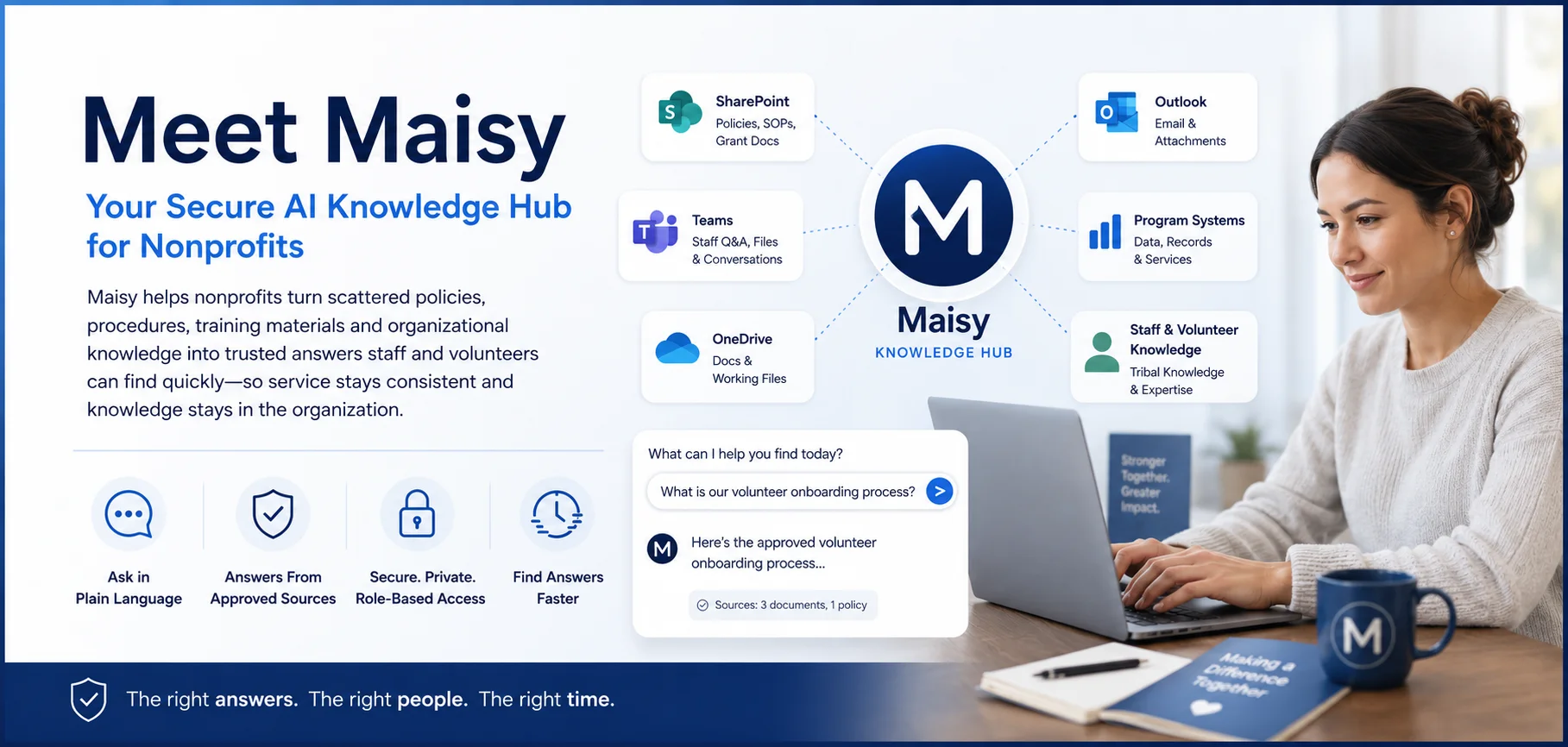
Maisy gives employees a conversational way to access approved organizational knowledge.
Staff may be able to ask questions such as:
- What is our volunteer onboarding process?
- Which incident-report form should I use?
- Where is the current employee handbook?
- What steps are required before launching a new program?
- Which policy applies to this situation?
- Who approves this expense?
- What documentation is required for this grant?
- What did leadership previously decide?
Answers are based on the approved sources connected to the knowledge hub.
Maisy is not meant to guess, replace professional judgment or search confidential information the user is not permitted to access.
We Do Not Replace the Systems That Run Your Programs
Your nonprofit may already use systems for:
- Donor management
- Case management
- Shelter operations
- Membership
- Church management
- Volunteer management
- Accounting
- Payroll
- Training
- Client records
Those systems perform important operational functions.
Pixeldust focuses on the organization behind those systems:
- Staff knowledge
- Volunteer instructions
- Human resources
- Policies and procedures
- Standard operating procedures
- Program documentation
- Grant information
- Compliance materials
- Records management
- Board and leadership knowledge
- Institutional memory
Your existing software manages transactions and records.
Maisy helps your people understand how the organization operates.
Understand. Organize. Empower.
1. Understand
We learn how your nonprofit operates, where information is stored, what employees struggle to find and which knowledge is at risk.
Discovery may include questionnaires, interviews, representative document reviews and a structured systems inventory.
2. Organize
We inventory, classify and restructure approved information.
This may include:
- Identifying duplicates and outdated documents
- Creating logical categories and metadata
- Separating information by audience and sensitivity
- Capturing undocumented knowledge
- Assigning content owners
- Establishing review and maintenance processes
3. Empower
We configure an appropriate way for employees to search and ask questions using approved information.
The organization tests the system, corrects weak sources, trains users and expands the knowledge hub gradually.

Built for Nonprofits with Growing Knowledge Problems
We work with nonprofits broadly, with particular experience and focus in several areas.
Human-Service Nonprofits
Support consistent programs, staff onboarding, policies, compliance procedures and knowledge continuity across teams and locations.
Examples include recovery organizations, family-service agencies, disability services, housing-support groups, food banks, foster-care organizations and community-service nonprofits.
Learn More: AI Knowledge Hubs for Human-Service Nonprofits
Education Nonprofits
Organize training materials, program procedures, curriculum support, operational records, policies and institutional knowledge.
Examples include education foundations, literacy programs, workforce-training nonprofits, scholarship organizations and youth education programs.
Learn More: AI Knowledge Hubs for Education Nonprofits
Animal-Welfare Nonprofits
Help shelter staff, volunteers and foster networks find approved procedures, training materials, safety information, HR policies and organizational records.
Maisy works alongside shelter-management software rather than attempting to replace it.
Learn More: AI Knowledge Hubs for Animal-Welfare Nonprofits
Churches and Faith-Based Organizations
Organize staff procedures, volunteer training, ministry information, facilities knowledge, HR policies and leadership records.
Maisy can work alongside existing church-management systems.
Learn More: AI Knowledge Hubs for Faith-Based Nonprofits
When Information Is Hard to Find, Everything Takes Longer
Nonprofit employees regularly waste time searching for information, asking the same people for help and recreating work that already exists.
Common problems include:
- Policies stored in different folders
- Conflicting versions of procedures
- Training dependent on individual employees
- Knowledge lost when staff members leave
- Volunteers receiving inconsistent instructions
- Program information isolated by department
- Grant and compliance records that are difficult to locate
- Important decisions buried in email or meeting notes
- Information scattered across documents and databases
These are not simply document-storage problems.
They are organizational knowledge problems.
Use the Microsoft Tools Your Team Already Knows
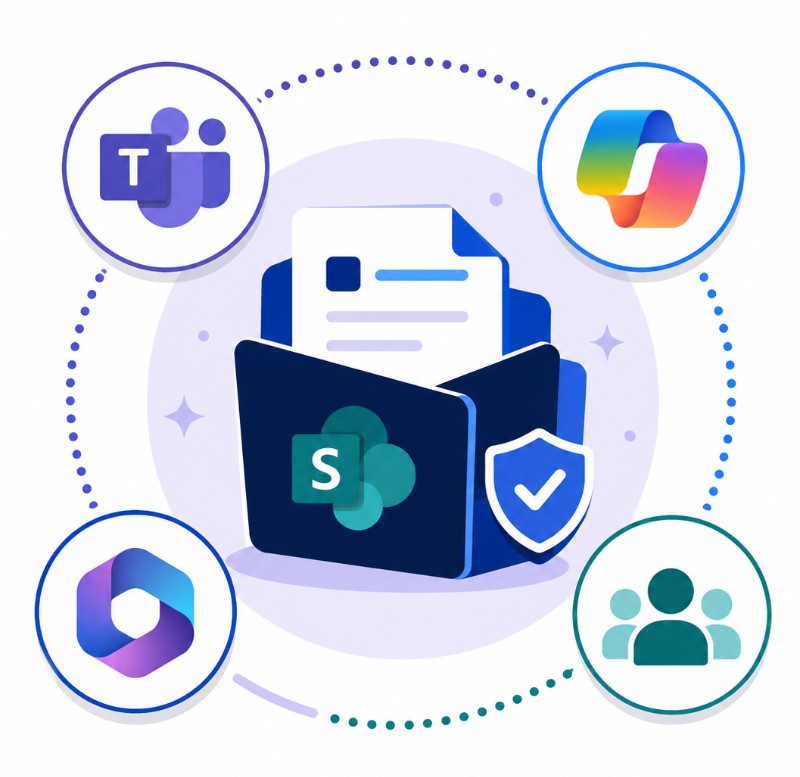
Many nonprofits already work in Outlook, Teams, SharePoint, OneDrive, Word, Excel and PowerPoint.
Maisy can use those tools as the foundation for an organized knowledge environment.
Depending on your licensing and requirements, the solution may include:
- SharePoint knowledge libraries
- Microsoft Teams access
- Microsoft Copilot
- Focused Copilot agents
- Power Platform connectors
- Dataverse
- Microsoft Graph connectors
- Structured content and permissions
- Document review and governance processes
The exact design is determined during discovery.
The goal is to improve access to knowledge without forcing your staff to abandon familiar tools or adopt another disconnected platform unnecessarily.
People Should Only See What They Are Allowed to See
A nonprofit knowledge hub should not make every document available to every employee.
Access may be separated for:
- Executive leadership
- Human resources
- Finance
- Program staff
- Development teams
- Board members
- Volunteers
- Contractors
For example, volunteers may receive access to approved volunteer procedures without seeing confidential employee, donor or client information.
Pixeldust reviews information sensitivity, user roles, Microsoft 365 permissions and knowledge boundaries during discovery.
Security is not automatic. It must be designed, configured and tested.
Your Nonprofit Already Has the Knowledge
Maisy helps you preserve it, organize it and make it easier for the right people to use.
Start by identifying where your most important information lives—and what your staff cannot find today.
Maisy Knowledge Hub™
Understand. Organize. Empower.
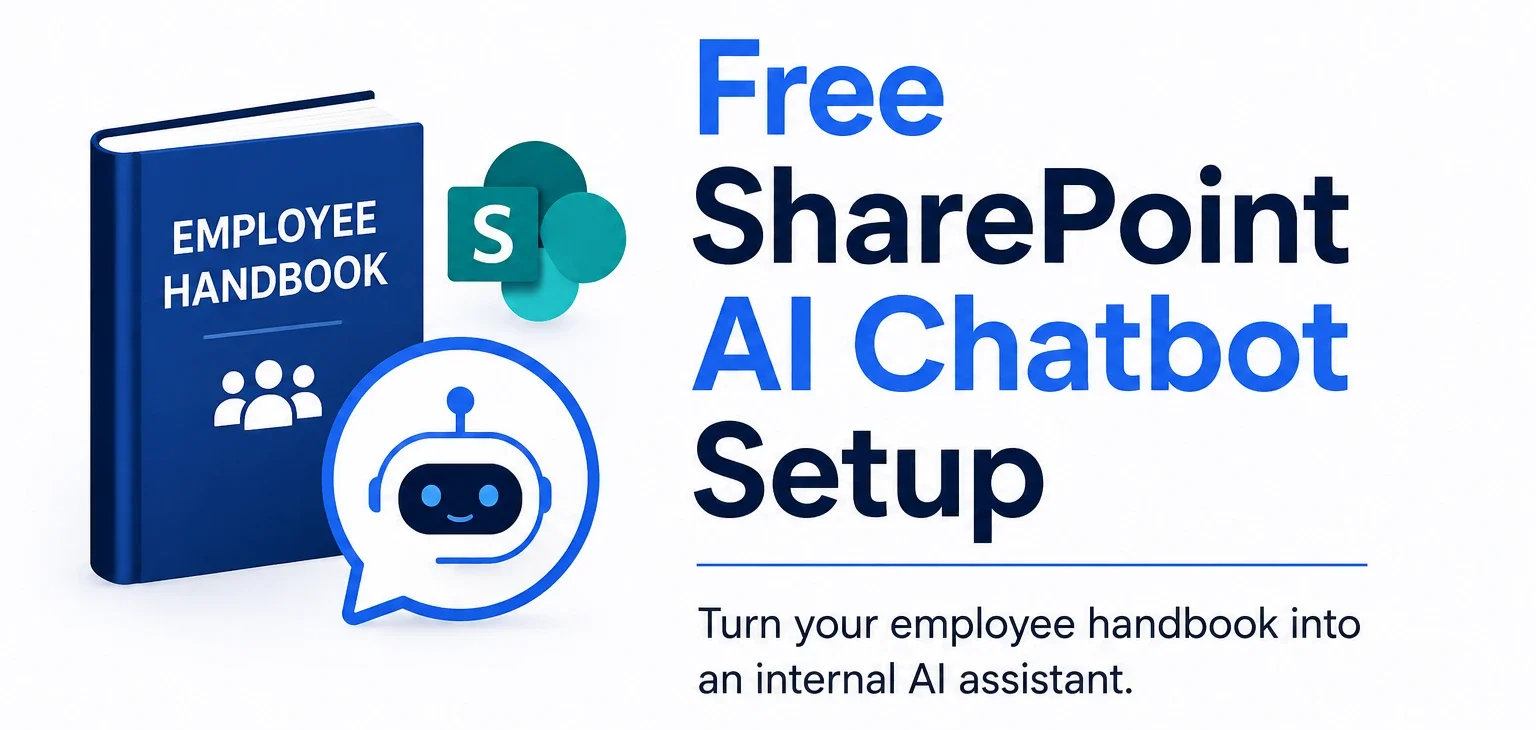
Free SharePoint AI Chatbot Setup
Turn one approved employee handbook into a working internal SharePoint AI chatbot. Employees can ask routine policy questions and receive answers based on your organization’s approved handbook inside Microsoft 365. The free starter setup includes configuration, testing and deployment for qualifying organizations.
Learn more about the free SharePoint AI chatbot setup
Free Guide: The Knowledge Capture Playbook
A practical system for extracting critical knowledge from employees, documents, workflows and real operational cases. This white paper includes prioritization scoring, interview scripts, workshop agendas, capture templates, evidence standards, validation controls, performance metrics and a 30/60/90-day rollout plan.
The Intelligence Compound: A New Operating Model for AI in Small Business
The Intelligence Compound presents a practical framework for implementing AI in small business. Rather than treating AI as a collection of isolated productivity tools, the paper explains how businesses can use it to preserve knowledge, support decisions, reduce owner dependency, identify operational problems, and improve processes over time. It includes original use cases, governance principles, real-world examples, and a 90-day implementation roadmap.
Thought Leadership
- NOG Accounting & Finance Brings CPA-Led Tax and Fractional CFO Support to College Station
- NOG Accounting & Finance Brings CPA-Led Tax and Fractional CFO Support to College Station
- NOG Accounting & Finance Brings CPA-Led Tax and Fractional CFO Support to College Station
- NOG Accounting & Finance Brings CPA-Led Tax and Fractional CFO Support to College Station
- DSC Web Services Builds on Web Design Since 1999 in Bryan
- All American Electric Brings Locally Owned Generator Support to Houston
- Swartz Green Electric Brings Qmerit-Certified EV Charger Service to Houston
- Backyard Pool Specialists Builds on 30+ Years of Custom Pool Work in Cypress
- DM Electrical and Construction Brings MBE, SBE and HUB-Certified Electrical Work to Houston
- Suncoast Plumbing Brings 24/7 Service Since 1999 to South Houston
- VR Electric Builds on Commercial and Industrial Electrical Work Since 1989 in Houston
- H&R Electric Company Brings Luxury Retail Electrical Expertise to Houston
- Byrd’s Maintenance & Plumbing Services Brings Minority- and Woman-Owned Plumbing Support to Houston
- Integrity Tax and Accounting Firm Connects Tax, Bookkeeping and QuickBooks Support in Baytown
- Grady’s Air Conditioning & Heating Services Brings Factory-Trained HVAC Support to Alvin
- Alpha 1 Roofing Offers Hail and Wind Damage Expertise in Alvin
- Performance Roofing & Construction Brings Certified Storm-Restoration Support to Alvin
- Texas Premier Residential Services Brings Family-Owned Roofing Expertise to Hempstead
- Conservation Contractor Brings 20+ Years of Land Development Experience to Navasota
- Air Care Brings Nearly 20 Years of Cooling and Heating Experience to League City