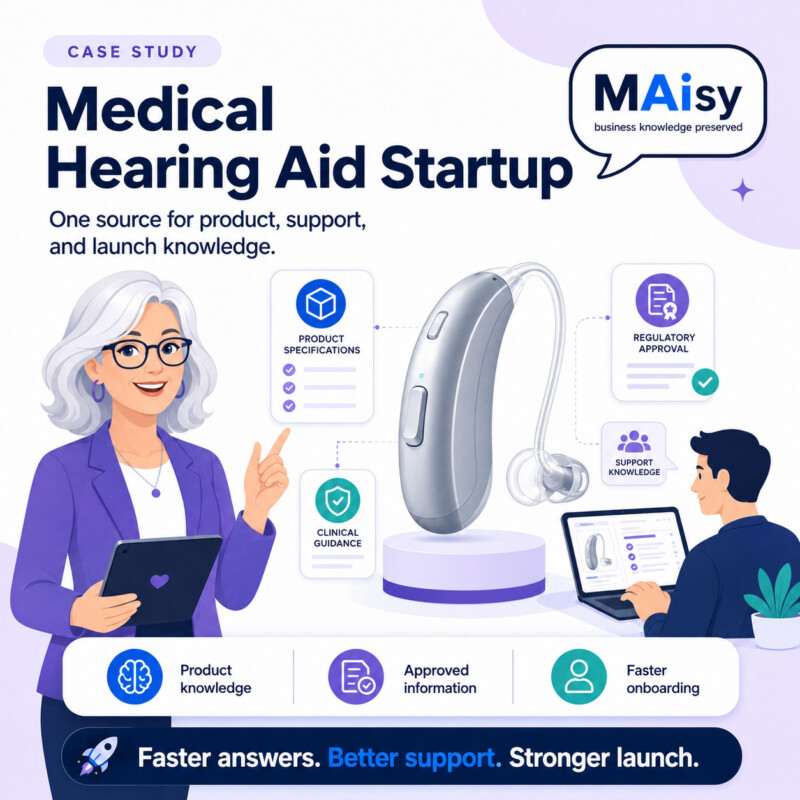
How an Austin Medical Device Startup Organized Critical Knowledge Before Launch
Company Overview
An Austin-based medical device startup developed a new hearing aid designed to improve everyday hearing support through modern hardware and software.
The growing team included product designers, engineers, clinical advisors, quality specialists, customer support staff, sales employees, and company leadership.
As the product moved from development toward commercialization, the organization accumulated large amounts of technical, clinical, regulatory, operational, and customer-facing information.
Much of that knowledge was difficult to locate and depended heavily on a small group of founders and technical experts.
The Challenge
During the early development stage, employees could usually ask a founder or engineer when they needed an answer.
That approach stopped working as the company grew.
Product specifications, testing notes, manufacturing procedures, research documents, training materials, support instructions, and approved marketing language were stored across email, SharePoint folders, PDFs, spreadsheets, meeting notes, and individual computers.
Different departments needed different versions of the same information.
Engineers needed current technical requirements. Customer support needed approved troubleshooting guidance. Sales employees needed accurate product descriptions. Leadership needed confidence that employees were using reviewed information rather than outdated drafts.
Employees spent too much time searching for documents or asking subject-matter experts to answer recurring questions.
What Was at Risk
For a medical device startup, inconsistent knowledge can create serious operational problems.
An employee using an outdated product specification could slow development. Incorrect troubleshooting guidance could frustrate customers. Unapproved product claims could create regulatory and reputational risk.
The company was also vulnerable because important knowledge remained concentrated among a few founders, engineers, and clinical specialists.
As hiring accelerated, the organization needed a reliable way to transfer knowledge without forcing senior employees to personally train every new team member.
The Pixeldust Solution
Pixeldust began by mapping the company’s major knowledge areas and identifying which employees owned the most critical information.
Interviews were conducted with leadership, engineering, product development, quality, clinical, sales, and customer support teams.
Existing files were reviewed and classified by purpose, ownership, approval status, and intended audience.
Pixeldust then organized the company’s SharePoint environment into a structured knowledge hub covering:
- Product specifications
- Device features and approved descriptions
- Engineering procedures
- Testing and validation records
- Manufacturing and supplier information
- Quality management procedures
- Clinical reference materials
- Customer support instructions
- Sales and product training
- Employee onboarding
- Internal policies and escalation paths
Draft documents were separated from approved operational content. Duplicate files were consolidated, outdated information was flagged, and missing procedures were documented with subject-matter experts.
Role-based permissions ensured that employees could only retrieve information appropriate to their responsibilities.
Maisy was connected to the approved SharePoint content and made available through Microsoft Teams.
How Maisy Was Used
A customer support employee could ask:
“What troubleshooting steps are approved when a customer reports feedback from the device?”
A salesperson could ask:
“How should we describe the product’s main benefits without making unsupported claims?”
A new engineer could ask:
“Where is the current device testing procedure?”
A quality employee could ask:
“Who must approve a change to a manufacturing process?”
A manager could ask:
“What training is required before an employee can access customer support records?”
Maisy provided answers from approved internal information and linked employees to the supporting source documents.
When several versions of a document existed, the knowledge hub established which version was current.
When no approved answer existed, Maisy identified the gap rather than creating an unsupported response.
Implementation
The project began with a discovery assessment focused on the company’s product lifecycle, departments, systems, and information risks.
Pixeldust collected documents from SharePoint, email, PDFs, spreadsheets, internal presentations, meeting notes, and employee interviews.
The information was reorganized using clear categories, ownership rules, access permissions, review dates, and document status labels.
Critical undocumented knowledge was captured from founders, engineers, clinical advisors, and quality specialists.
Maisy was configured to use only approved content from the knowledge hub.
Testing was performed using real questions from engineering, sales, support, quality, and leadership.
Employees were then trained to access Maisy through Microsoft Teams and to use SharePoint as the controlled source for updated company knowledge.
Results
Employees spent less time searching for technical and operational information.
Customer support gained faster access to approved troubleshooting procedures. Sales staff used more consistent product descriptions. New employees became productive without depending entirely on founders and senior engineers.
The company also gained better control over which documents were current, which were still drafts, and who was responsible for reviewing them.
Repeated questions decreased, allowing technical and clinical experts to focus on product development, testing, and complex decisions.
Most importantly, the company’s knowledge became an organizational asset rather than information held by a few individuals.
Before and After
Before Maisy, employees searched through emails, folders, and multiple document versions or contacted a subject-matter expert.
After Maisy, employees could ask questions in Microsoft Teams and receive answers from approved company information.
Before Maisy, founders and engineers repeatedly explained the same procedures.
After Maisy, their documented knowledge was available across the organization.
Before Maisy, new employees had to learn which documents and employees could be trusted.
After Maisy, the knowledge hub clearly separated current, approved information from drafts and outdated files.
Before Maisy, growth increased the risk of inconsistent information.
After Maisy, the company had a controlled knowledge foundation that could scale with the team.
Key Takeaway
The startup’s challenge was not a lack of knowledge. It was that critical information was scattered, difficult to verify, and concentrated among a small number of experts.
By organizing approved information in SharePoint and making it accessible through Maisy in Microsoft Teams, the company improved consistency, reduced dependence on key individuals, strengthened onboarding, and created a more reliable foundation for bringing its hearing aid to market.