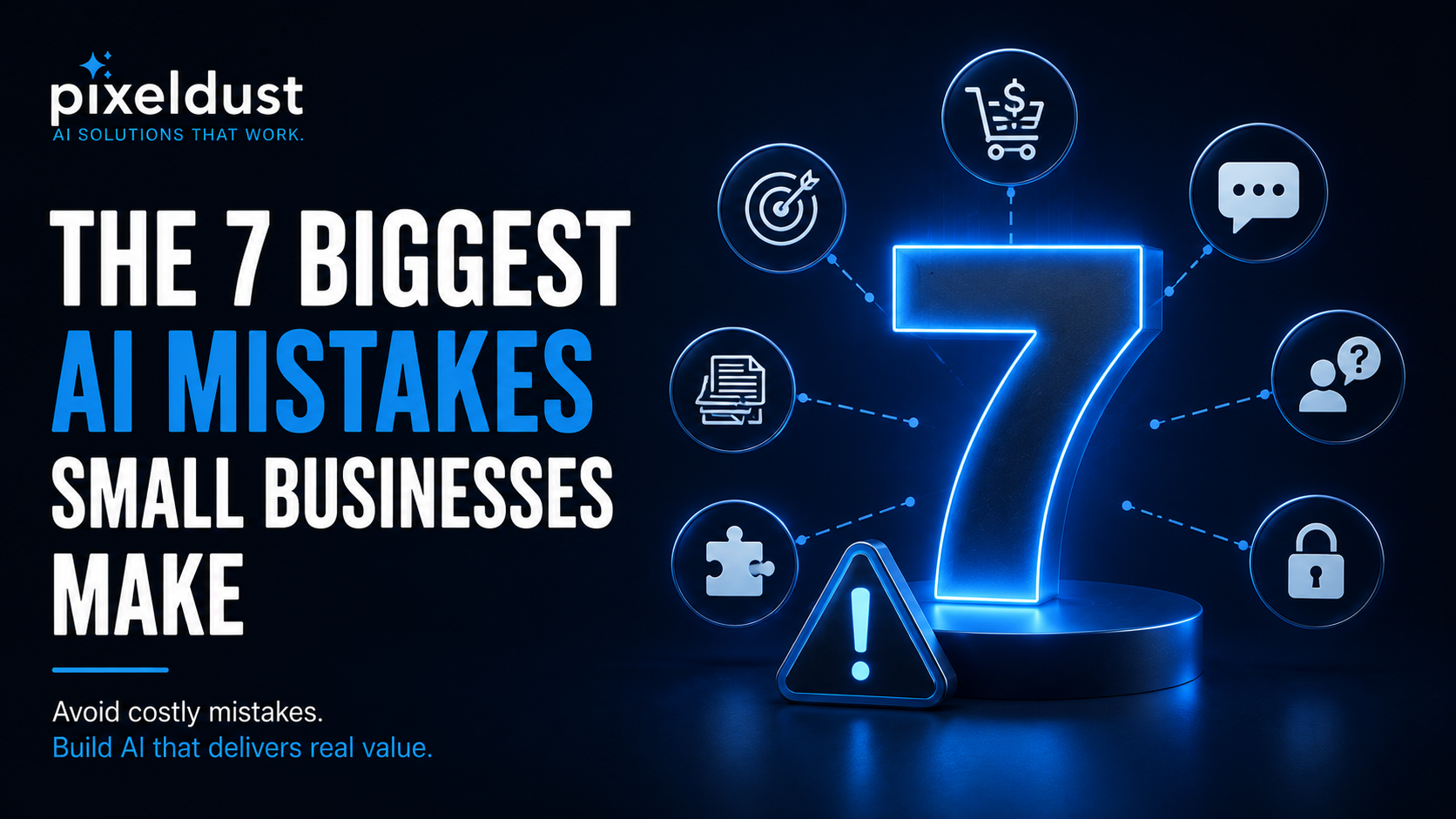
Artificial intelligence can save time, improve customer service, and help employees work more efficiently. But many small businesses rush into AI without building the right foundation first.
Here are seven common mistakes that can waste money and create more problems than they solve.
1. Buying AI Without a Clear Business Goal
AI should solve a specific problem.
Start by identifying where your team loses time, where customers experience delays, or where employees repeatedly search for the same information. Then determine whether AI can improve that process.
Buying software without a defined use case usually leads to low adoption and disappointing results.
2. Building a Chatbot Before Organizing Your Information
A chatbot is only as reliable as the information behind it.
If your policies, procedures, pricing, and service information are outdated or scattered across different systems, the chatbot may provide inconsistent answers.
A successful AI project starts with organized, approved business knowledge.
3. Expecting AI to Automatically Know Your Business
ChatGPT and Microsoft Copilot understand language, but they do not automatically understand your company.
They do not know your processes, customers, policies, or internal decisions unless that information is made available through a structured knowledge system.
4. Ignoring Tribal Knowledge
Some of your most valuable information may exist only in the heads of experienced employees.
When those employees retire, leave, or become unavailable, that knowledge can disappear. Capturing it through interviews, documentation, and structured processes protects the business.
5. Treating AI as Only an IT Project
AI affects operations, sales, HR, customer service, leadership, and finance.
The best projects involve the people who perform the work every day. Technology supports the solution, but the business must define what success looks like.
6. Trying to Automate Everything at Once
Start small.
Focus on repetitive questions, document searches, onboarding, or simple support tasks. Early wins are easier to measure and help employees become comfortable using AI.
7. Skipping Security and Permissions
Employees should only receive information they are authorized to access.
AI must respect the same permissions already used across SharePoint and Microsoft 365. Security cannot be added after the system is built. It must be part of the design from the beginning.
At Pixeldust, we help businesses avoid these mistakes by building the knowledge foundation first. We collect, organize, and structure business information so AI can provide accurate answers from trusted sources.
Before investing in another AI tool, find out whether your organization is ready.
Schedule a free AI Readiness Assessment at pixeldust.net/assessment. We will identify knowledge gaps, practical opportunities, and the steps required to implement AI responsibly.
A stronger AI strategy starts with better business knowledge.